
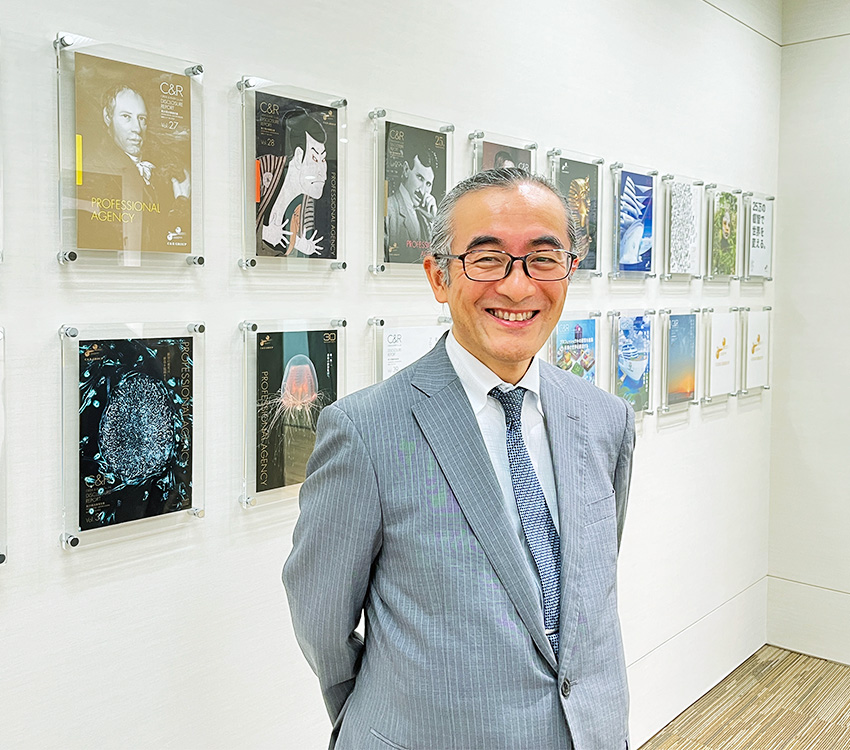
Co-creation & innovation begin with "talking"! The unexpected turns reveal new themes and insights
i2.JP is an open innovation network that brings together various players interested in healthcare to solve problems through collaboration.
How do partner companies meet and collaborate with co-creation partners?
We interviewed Masumi Kanai, Senior Director, Business Development Division, Medical Principle Co., Ltd., who is actively meeting with partner companies via i2.JP.
Turning doctors’ "would be nice to have" ideas
into commercially viable clinical needs
by connecting with corporate technology and strategy
――Could you tell us about yourself first?
Medical Principle operates in the medical and healthcare sectors under the Creek & River (C&R) Group and is committed to "enhancing the lifetime value of doctors" and "contributing to the creation of value for medical institutions" through its mainstay "Minkan Ikyoku", a job search support service for doctors.
I joined in 2011 and have been working on business development since 2019. We started by bringing together healthcare and its related fields, and have been striving ever since to contribute to the future of healthcare through out-of-the-box thinking that crosses boundaries. The C&R Group has a network of over 390,000 professionals in 18 highly specialized fields, and this resource is one of our strengths.
――Could you tell us about the projects you have worked on so far?
We have been working on projects such as "Healthcare x VR", "Healthcare x AI", and "Healthcare x Drone" together with technology startups and doctors. In terms of funding, we have built a platform to use crowdfunding, which strongly encourages doctors to take on challenges.
While working on these projects, we noticed a growing sense of crisis among doctors that healthcare will decline unless they look beyond healthcare and proactively embrace cutting-edge technology. We then supported a doctor who had a sense of crisis and an idea for a medical device, and the crowdfunding was a great success, leading to the creation of a prototype at the C&R Group. This led to the launch of the "Design Kobo (design studio)" for "would be nice to have" in healthcare as a new development platform for medical and healthcare devices, including SaMD.
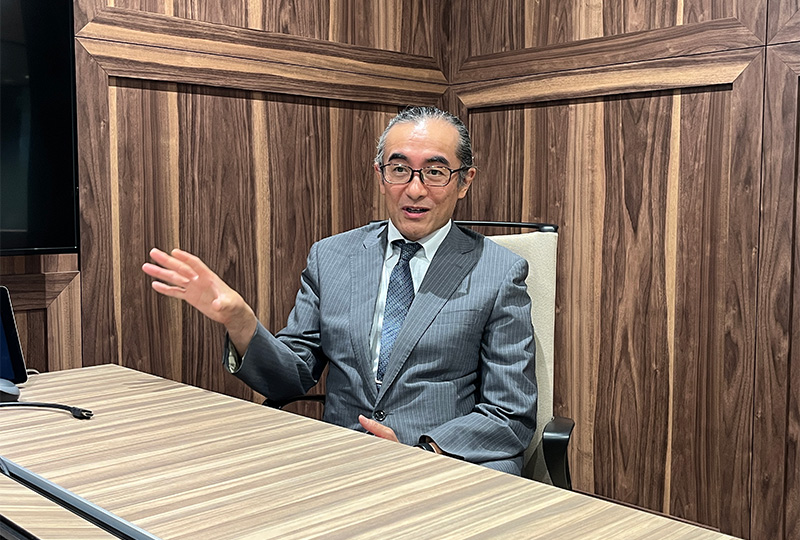
――Is this a project to materialize the "would be nice to have" ideas of doctors?
Yes. We started this as a platform to collect the "would be nice to have" ideas from the member doctors of “Minkan Ikyoku”, and then I would communicate with the doctors to turn these into "commercially viable clinical needs", and then approach companies that have technologies and strategies that match these needs to see if they would be interested in collaborating. We can't judge the "commercial viability" of the doctors' "would be nice to have" ideas, so the Kobo acts as a "bridge" between doctors and companies.
We have a network of over 160,000 members, including doctors and medical students, from our "Minkan Ikyoku", and by calling on just around 400 members, we were able to quickly gather over 150 "would be nice to have" ideas. While some doctors had very specific ideas, there were others who simply "didn't know" about the companies' projects, so I shared them with the doctors to highlight further clinical issues. In this way, I keep bouncing ideas off the doctors.
From the company's point of view, it is very convenient to have a group of doctors who have issues that are aligned with the company's strategy. Such doctors can also be partners in the development process and help with clinical trials. We can also expect an impact on public relations and opening up distribution channels after the product is launched. This service of building a panel of supportive doctors is quite popular.
Leveraging open innovation
to actively offer meetings
“Hypothesis of co-creation" that resonates with others
――When did you join i2.JP?
I joined in 2021, but started actively utilizing it in 2022. The expertise related to the development of medical and healthcare devices, including SaMD, is wide-ranging, and it is not at all practical nor speedy to handle everything in-house, so we always try to adopt open innovation strategies. We also use other platforms, but it is difficult to tell how interested members are in healthcare. In this respect, i2.JP is very helpful because member companies are basically very healthcare conscious.
――What are your sources of information?
I always read the section in the monthly newsletter introducing the new companies that have joined. I carefully examine the business and technology of each company, while comparing it with the business model of the “Design Kobo” in my mind. When I get a co-creation inspiration, I ask the i2.JP staff to arrange a meeting, giving specific reasons, such as "There is a doctor with an idea for XX, and I think this company's XXX technology could be used".
For example,
- Clinical issues raised by doctors → Companies with technologies and materials that may lead to solutions
- Funding for innovative therapeutic devices → Companies investing in that area
――Because you always have business concepts and ideas in mind, you can make concrete proposals.
Right. Before we launched the Kobo, there was a time when I would approach different companies as ideas came to me. Now I think it may be necessary to formulate your own co-creation hypothesis and communicate it clearly. Just saying "I'm interested, so I want to meet" is not enough to impress someone else. By the way, I have been told that my request for a meeting is more likely to be accepted than others, and I think this is because I am able to create a co-creation hypothesis that is beneficial to both parties. I think it is the pride of those involved in business development to hone our ability to generate such hypotheses.
Getting to know each other is
sowing seeds for the future
Co-creation can sprout over time
――What do you keep in mind when meeting with partners?
While clearly stating our objectives based on the co-creation hypothesis, I also try to leave room for things to "unexpectedly turn out". This is because unexpected responses often contain new themes and insights. If we can leave room for playfulness in the dialogue, while setting clear objectives, it often leads to an interesting meeting.
――Have you ever collaborated with i2.JP partners?
We recently collaborated with Medii and publicized their "3rd Medii Clinical Grand Prix" in our media. In this competition, young doctors form teams and take on difficult cases that are presented by experts in each area. We also participated in the competition with a team of doctors who regularly serve as panelists on the "Minkan Ikyoku Connect". Here you can read an article about the competition results and experiences*
※Minkan Ikyoku Connect Article: The winning team of the "3rd Medii Clinical Grand Prix" is announced!
By the way, Medii provides a service to share the knowledge of medical specialists under the vision of "Leave no Patient Behind”. With the connection between Medii's network of medical specialists and our broad network of doctors as a starting point, we hope to continue to build on co-creation.
――Is there anything that you can only find out after meeting with partners?
Rather, there are many things you don’t know unless you talk to them. I meet with partners virtually, and I have honed my questioning skills to subtly probe for nuances not officially stated by the company, the passion of the company and the person in charge of the project, and the allocation of emphasis to each strategy, as well as my observation skills to read a lot from the partners' responses, pauses, and even word choice.
As a result, we have sometimes received "homework" assignments, such as "think of new applications for our XX technology", even if the project is not underway. It would be ideal if we could immediately start working as we envisioned for co-creation, but that is not always possible. In some cases, the initial proposal did not work out as expected, but an alternative proposal turned out to be successful and the deal was concluded.
The business environment is constantly changing, and once partners get to know the company and the personality through conversation, it can lead to "planting a seed" that will one day sprout and blossom. Therefore, I think the key to success is to make an impression during the meeting that I am "interesting" and "usable”.
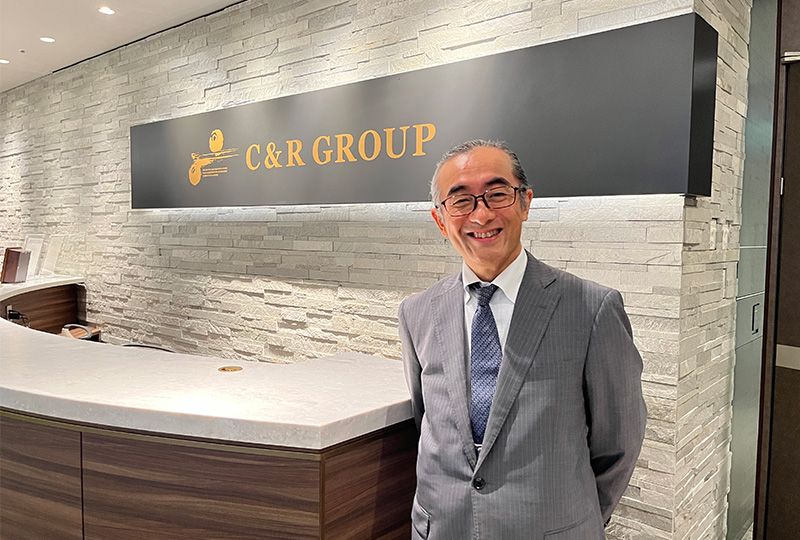
――What do you expect from i2.JP in the future?
I believe that open innovation should be "on an equal footing" regardless of scale, so I empathize with i2.JP's style of "promoting equal relationships" between various players, and I hope that you will continue to value this. Small companies provide creativity and speed, while large companies provide information and resources, to create value for society by exchanging them with each other. I hope that i2.JP will be an ecosystem where such exchanges happen organically and spontaneously.
It occurred to me as we were talking that it might be a good idea to have a "breakout room" type structure in the process. For example, at the Kobo, we are currently thinking about creating breakout rooms for things like "SaMD", "PHR", and "3D printers". I think that if there is a place where people who are interested in or related to a particular topic can meet and exchange views, it will deepen the discussion and refine the project. If this were to happen, it would be great if members from our & your breakout rooms could work together to plan something. Let's grow together as i2.jp and the Kobo create opportunities for collaboration.
For inquiries
Interested in joining us?
Thank you for your interest. We will get in touch soon.