
After the company-wide project
taxi company's own COPD awareness campaign is underway
※You can read Part 1 from here
In Part 2, we will share the details and results of the company-wide rollout, as well as continued rollout and future challenges.
The challenge is to encourage people who decide to go to the doctor
when they have symptoms to seek medical attention
―― Could you describe the company-wide rollout and share the summary of the results?
Shinke: The target was 5,249 drivers from 12 Nihon Kotsu Group companies, of whom 1,346 were eligible for the seminar and 988 participated. The design of the seminar and the survey was almost the same as in the pilot version.
Ishiguchi: We asked the audience to participate in one of three ways: group viewing of the live webcast, group viewing or individual viewing of the video, and about 90% of the participants said they "understood/understood well" in all viewing modes1.
Okoba: Regarding the medical examination that we were most interested in, 35.0% of the respondents stated in the post-survey that they intended to see a doctor, 7.9% responded that they had seen a doctor in the survey one month later, and 60.4% of them had been diagnosed with COPD1.
Ishiguchi: Some respondents said they would like to be examined one month later, but I don’ t think they will go to see a doctor after one month or more. Our future challenge is that many people have learned about COPD and thought, "I need to get tested someday," but have not gone to the doctor.
―― Why don’t they go to see a doctor?
Ishiguchi: The most common reason for not intending to see a doctor, or for having intended to see a doctor but did not, is "no symptoms at the moment.” Many said they would see a doctor if they have problems in their daily lives.
Shinke: In order to identify factors that help change behavior, we included questions in the survey such as “Would you go to see a doctor if there was financial support for the test?” and “Have you talked to your family about COPD?”. The findings show that whether or not they have symptoms is a very important factor. If that is the case, how can we get people who don't have symptoms now to imagine what it would be like to have COPD in the future? We need to devise ways to encourage people to go to the doctor.
―― Any other insights you gained from the survey?
Shinke: There were more people who quit smoking or reduced smoking than expected.
Okoba: The pilot project showed that around 60% of smokers had either quit or reduced smoking, and the company-wide rollout saw 43.4% of smokers either quit or reduce smoking. Out of people who thought about quitting or reducing smoking after the seminar, 77.8% actually took action (29.0% quit smoking, 48.8% reduced smoking). Although we had a challenge in encouraging people to visit the doctor, I think the seminar was effective in that it gave people who would otherwise have been unaware of their COPD risk the opportunity to learn about it. Including smoking cessation and smoking reduction, I think there was a certain effect on changing awareness and behavior, and I think that this was also highly evaluated by Nihon Kotsu1.
―― Please tell us about the continuous program.
Shinke: The company-wide project ended in 2022, but it has continued in a different format since 2023. Nihon Kotsu's own CWO-led initiative involves conducting COPD-PS during health check-ups and encouraging people at risk to watch the video.
Okoba: One of the major issues with disease awareness events such as public lectures is that they tend to be one-off, so from early on we were talking about whether it would be possible to continue working on COPD even after the collaboration with AstraZeneca had ended. When the company-wide rollout had progressed to a certain extent, Shinke-san and Nihon Kotsu discussed the matter and decided to continue. I am very happy to see it come to life.
Shinke: After discussing with Nihon Kotsu about a way that would be easy for the company to continue, we decided to use health checkups. This is because health checkups in the taxi industry are often held within the company, with everyone receiving their checkup at the same time on a fixed date and time. However, it is difficult to hold seminars with doctors, so we encourage those at risk to watch the videos on AstraZeneca's corporate website.
Ishiguchi: After the continuous program had started, we interviewed Nihon Kotsu, and they told us that the program was being implemented without any problems. Taxi drivers are required to have a health check-up twice a year, and the program is being implemented at both of these times.
If there is a proactive "flag-bearer"
corporate governance could have a positive impact
―― Please tell us about the strengths of your partner that you found through the collaboration, and your honest impressions.
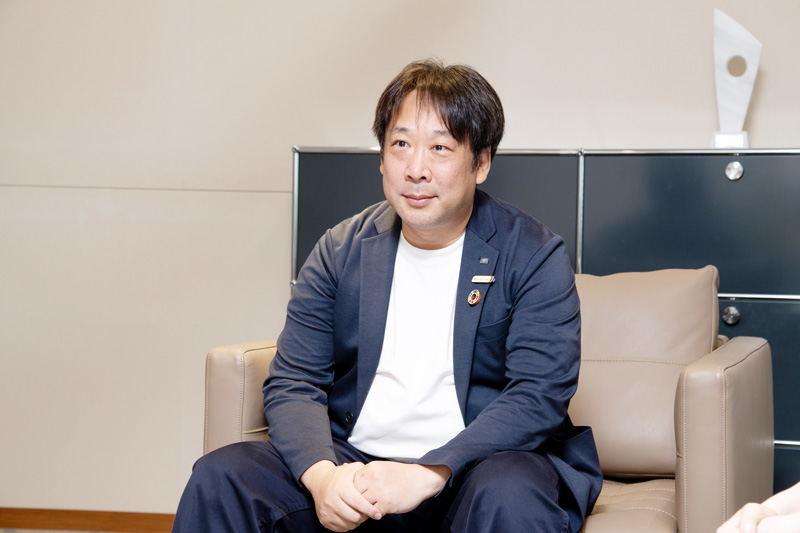
Ishiguchi: I met Shinke-san for the first time through this project. He was very powerful, and I was moved by his enthusiasm to “do something new together.” It takes courage, stamina and energy to take on new challenges, but I felt like “let's do it!” and “we can do it!”.
Shinke: The tourism industry is built on collaboration with various business partners. This project, which contributes to the health of people working in the industry, was something I felt strongly that I should do and wanted to do, and that may have been the source of my energy.
This project was new to both of us, and it was something that was clearly meaningful and would definitely be useful, so I really enjoyed it. There were some difficult moments, but it was great to see changes in awareness and behavior of the drivers, and I think it was a great achievement that it led to continued rollout. I am grateful to both Nihon Kotsu and AstraZeneca.
―― Can this achievement be used for future COPD awareness campaign?
Okoba: Regarding the method of holding seminars at companies for their employees, I interpreted the hypothesis that corporate governance might affect seminar participation, awareness change, and behavior change as positive. At the same time, I also realized that whether or not there is a leader is the key.
Shinke: I think that Naka-san was the key person in this project, but Ouchi-san, who was in charge of the pilot version, also played a big role in leading the project. We learned that the high awareness of the management team was a prerequisite and the part that connects the front line and the management team is important. In that sense, when implementing a similar project in another company, we need to try something new.
However, from the perspective of absenteeism, presenteeism and branding for companies, this type of disease awareness activities is certainly something that companies should be doing and that will be beneficial to them. If, for example, Nihon Kotsu continues this initiative over the medium to long term and figures such as a decrease in the employee turnover rate and an increase in productivity are achieved, this can be used to appeal to external parties, and other companies may follow suit.
―― Is there anything you want to achieve through i2.JP in the future?
Okoba: I think that continued efforts are needed to raise awareness of COPD, and I also hope that we can gain new perspectives and methods. This time we focused on taxi drivers, but there may be discoveries to be made by targeting different audiences. I hope that we can take advantage of the i2.JP framework to gain new opportunities.
Shinke: I am thinking about how we can make use of JTB's strengths to contribute to patient experience design in some way. When patients are undergoing treatment, “travel” is often mentioned as something they want to do. This is also the result of JTB’s awareness survey. The next step after seeing a doctor and receiving a diagnosis is to continue with treatment. I think that travel can be one of the motivations for continuing treatment, so I would like to collaborate with i2.JP partner companies to create something that will help patients continue with their treatment by linking their travel experiences to their treatment.
※The information in this article was current at the time of the interview. Please note that affiliations, etc. may differ from today.
For inquiries
Interested in joining us?
Thank you for your interest. We will get in touch soon.