

A data-driven approach
to change behavior of those at risk for chronic kidney disease (CKD)
For early detection and early treatment of CKD - Using checkup/claims data to build a model to encourage behavior change through a personalized approach
Chronic kidney disease (CKD) is considered a national disease with an estimated 13.3 million patients in Japan, or one in eight adults.1 As advanced CKD may require dialysis, early detection and treatment are important. However, it is not uncommon for patients not to notice the disease until it has progressed, as there are no symptoms in the early stages.
Therefore, AstraZeneca and PREVENT, a company that analyzes medical data and supports the prevention of serious lifestyle diseases, launched a CKD awareness project.
We interviewed Kento Takeyama, Department of Business Planning, PREVENT and Liu Lei, i2.JP Director at AstraZeneca, about their project. In part 1, we look at how their collaboration began and the characteristics of the project.
PROJECT CASE
- Overview
-
- Send disease awareness letter to people at risk of CKD and undiagnosed, based on health checkup/health insurance claims data from health insurance associations.
- Segment the target audience based on background information and other data, and tailor the message to the characteristics of each group based on the nudge theory2
- Backgrou
nd/Issue -
- For CKD, early detection is an issue because advanced CKD may require dialysis.
- Health insurance associations provide health advice mainly on lifestyle diseases and may not cover other diseases.
- Validation
result -
- The data was used to set and evaluate outcomes and the control group, and the results showed that 42% of the 740 subjects (about 150% of the control group) changed their behavior.
CKD is a major social issue, with a need for health insurance associations to raise disease awareness
―― How did you start working together on CKD awareness?
Kento Takeyama:At PREVENT, we came up with the idea of disease awareness for CKD before joining i2.JP in October 2021. We knew that AstraZeneca had been actively involved in various activities in CKD over the past few years, so we proposed a disease awareness program when we joined, which was agreed by the end of the year. We started a proof of concept (PoC) in April 2022, and things have progressed very quickly.
Lei Liu:AstraZeneca is focusing on raising awareness of CKD, with activities such as TV commercials and public lectures for the general public, but the lack of a way to reach each and every undiagnosed patient had been a major challenge. PREVENT's proposal addressed our challenge in that we could use health checkup and health insurance claims data to raise awareness of people who are at risk but have not yet visited their doctor. It was also attractive that we could cooperate with health insurance associations and that the three parties could work together.

―― Why are you focusing on CKD?
Liu:First of all, as a social issue, CKD can lead to dialysis as it progresses. Japan has the second highest number of dialysis patients per million people in the world3, with direct medical costs totaling 1.57 trillion yen per year (estimate)4, and dialysis treatment may have an indirect impact, such as affecting patients’ employment and reducing QoL. Moreover, CKD is expected to increase further in the future.
Meanwhile, when we think about individual patients, they may have few symptoms in the early stages and are often unaware of their condition until it has progressed, which is why AstraZeneca is working on disease awareness.
Takeyama:PREVENT provides medical data analysis and health support services to health insurance associations. When we interviewed health insurance association officials, we found that although education and advice on lifestyle diseases are often provided and they know that recommending a doctor's visit for CKD is very important, they lack the resources and know-how to do anything about it. In particular, there is a great need among public health nurses in the field. In fact, when we approached health insurance associations about participating in this project, three of them immediately agreed, saying it was a great opportunity.
Materials interspersed with audience insights and nudge theory
with education for doctors in sight
―― Please give us an overview of the project and its features.
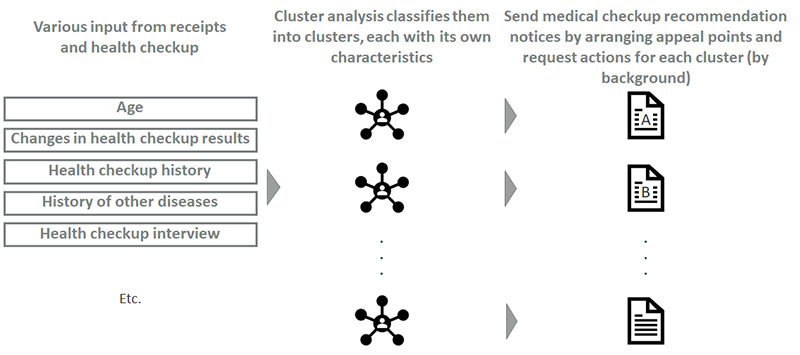
Takeyama:Its feature is "data-driven personalized medical checkup recommendation”. For general medical checkup recommendation, the same notification is sent to all eligible persons, partly due to resource issues. Although it would be more effective to personalize the recommendations according to the target group, it is not realistic to provide different types of content to each individual. Therefore, we use data to divide the audience into several groups and tailor the recommendations to the characteristics of each group.
First, people at risk of CKD who have not yet been diagnosed are selected from the health checkup and health insurance claims data. Next, they are divided into groups, the characteristics of each group are analyzed, and materials for recommending medical examinations are prepared according to the characteristics and sent to individuals. Finally, the behavioral change of the target population is assessed using the health insurance claims data.
Liu:The two points of focus here are "data-driven" and "verified with data”. Data-driven selection of the target audience, grouping them, analyzing insights, considering how to approach, following the behavioral changes with data, and verifying the effectiveness. In addition, we also monitor the individual patient journey. It is full of features that we have not been able to realize or wanted to do.
Takeyama:The fact that we were able to build a model based on health checkup and health insurance claims data as a joint project with health insurance associations is a unique feature of this project and one of the reasons why we were involved.
●Data-driven personalized medical checkup recommendation
―― How did you group the audience?
Takeyama:While receiving input from specialists and AstraZeneca, we divided the audience into seven groups based on information such as "CKD stage," "treated or not treated for lifestyle diseases," "lipid, blood pressure, and blood sugar levels," and "hospital visits in the last year”. Here we focused on gaining a better understanding of the people in each group. For example, "people who have already been treated for lifestyle diseases → let's just tell them to see their doctor", or "people who haven't been to hospital in the last year → we need to find a way to lower the barrier to hospital visit", and so on. We analyzed the data for insights and refined the message we should deliver.
―― So you have made seven different kinds of materials for disease awareness.
Liu:Yes. Materials are full of ingenuity! The challenge with conventional disease awareness materials is that people don't see them or take action. Therefore, we have incorporated the nudge theory into the materials. First, get them to recognize the risks. Get them to understand some of the causes. We also help them understand the risks if the risks are left unchecked. Finally, we lower the hurdle to seek medical attention, and have them change their behavior on their own. By dividing them into groups, we were able to reflect the nudge theory in the materials.
Takeyama:As I mentioned earlier, we spent time analyzing the insights of each group, then used the Fogg Behavior Model5 to sort out the points that would resonate most with each group, and finally incorporated them into the materials. The design and key phrases were decided in the later stages of the project, and I think that the preliminary stages were very important.
●Disease awareness material sample

Liu:We included the message "Please bring this notice with you when you visit your doctor" on all materials. This is to ensure that the information is delivered to doctors through patients using the materials.
We know from previous surveys and other studies that there are many cases where they are not aware of kidney risks, even when they are treating patients for lifestyle diseases, and that there is a gap between nephrologists and non-specialists in recognizing kidney risks. We also provide information to doctors, but we are not able to reach non-specialists, so we thought that if we could get information from patients to doctors, and if doctors were also aware of the risk of CKD, there would be more opportunities for patients to receive appropriate testing, diagnosis, and treatment. In fact, this hypothesis has also been tested. In this sense, too, the project has been very fruitful.
―― Have you had any difficulties or worries?
Takeyama:We closely shared information with AstraZeneca and received advice each time during the project. We had no problems or anxieties at all.
Liu:The project was the smoothest we have ever experienced! ! It was well planned and the health insurance associations were willing to help us. Both the contents of the materials and the verification scheme were good, and I think the high quality of PREVENT was a major factor in the smooth progress of the project.
Takeyama:It proceeded surprisingly quickly, and we really appreciated it. Timing is important for health projects, and in fact, approaching in early spring works best. If we had been one step late, the project might have been implemented the following year.
Liu:I may have gone "super fast" in terms of internal arrangements (laughs), but I felt that this was definitely a project that needed to be done. In fact, the results exceeded my expectations.
There are many things you can't know about unprecedented projects like this unless you try them out. I think the ideal form and fascination of open innovation like i2.JP is to start small as a PoC and learn from it.
※The information in this article was current at the time of the interview. Please note that affiliations, etc. may differ from today.
※Please click here to read the part2 of the report, which describes the project's evaluation methods, results and subsequent developments.
For inquiries
Interested in joining us?
Thank you for your interest. We will get in touch soon.