

Ovarian Cancer Awareness Project(Part1)
Restroom signage for the high-risk population, with surveys to explore behavior change
In Japan, ovarian cancer is the third most common cancer in women after breast and endometrial cancer. In recent years, the incidence of ovarian cancer has increased and is now more common than cervical cancer1. However, the disease is not well known to the general public and women do not seek medical help even when they have symptoms.
Therefore, AstraZeneca and OiTr, which provides free sanitary napkins in restrooms, launched an ovarian cancer awareness project.
We interviewed Hiroki Eguchi and Aoi Sumimoto from OiTr, Inc. ("OiTr") and Masashi Takuma from AstraZeneca about the companies' efforts, how the project started and what it entails.
PROJECT CASE
- Overview
-
- Delivered the 15-second restroom signage ads to facilities frequented by women in their 40s and 50s, who have a higher incidence of ovarian cancer (a total of 56 facilities, including commercial facilities, offices, and transportations, 995 units, 60 days from July to September).
- Conducted a survey on advertising to those who used OiTr during the period.
- Backgrou
nd/Issue -
- Although the incidence of ovarian cancer is increasing, the disease is not well known to the general public, partly because the government does not encourage screening.
- In the early stages, symptoms are rarely noticed, and when they do occur, they are often unnoticeable because they are not specific to ovarian cancer.
- The survey suggests that basic knowledge of ovarian cancer "leads to earlier diagnosis" and "better understanding of treatment."
- Results
-
- We can effectively raise awareness of ovarian cancer among the target audience by utilizing the private space of the restroom.
- Further efforts are needed to measure the effectiveness of advertising (tracking behavior changes).
A shared concept of eliminating dissatisfaction with women's health care was the starting point for the project
- Firstly, can you give us some background on the project?
Takuma: AstraZeneca has two visions in ovarian cancer: to improve the five-year survival rate of patients with ovarian cancer and to create an environment in which patients can be satisfied with treatment. However, we have focused on providing information to those with ovarian cancer and have not conducted disease awareness activities for those without the disease. One reason for this is that there is no clear evidence that screening has improved early detection or survival rates. There is also no government-recommended screening for ovarian cancer, which we believe is another reason why ovarian cancer is not well known.
Meanwhile, there are few symptoms in the early stages of ovarian cancer, and when symptoms do occur, they are not specific to ovarian cancer, and by the time they are noticed, the disease is already advanced in some cases. In a survey of patients, some said that if they had had knowledge, they might have seen a doctor earlier and been more proactive in their treatment. In response to these comments, we decided to work on disease awareness, believing that making more people aware of ovarian cancer would lead to early detection and improved satisfaction with treatment.

- How did you come up with the idea of restroom signage?
Takuma: The idea was born during an internal workshop organized by the Ovarian Cancer Team and i2.JP. The workshop brought together various employees from different therapeutic areas and functions to discuss issues and ideas for raising awareness of ovarian cancer and we came up with the idea of putting ads in restrooms. The idea for the restroom signage was not born while discussing an advertising medium, but by imagining a woman's daily life and asking ourselves when would be the best time for women to see it.
Ovarian cancer is estimated to affect approximately 13,000 women annually1. We thought it would be more efficient to provide information directly to those at high risk of contracting the disease, rather than using TV commercials and the like for the general public. The incidence of ovarian cancer begins to increase from around the age of 40, with the most common age group being those in their 50s and 60s1, so we thought restroom signage would be a suitable tool to deliver information to women in that age group, and consulted our i2.JP partner OiTr.
Eguchi: Restroom signage is characterized by a high awareness rate because the advertisements are viewed in a private space. OiTr can be used to deliver advertisements only to women in facilities frequented by the target group, so when I heard from Takuma-san, I thought it was the right medium for ovarian cancer awareness.
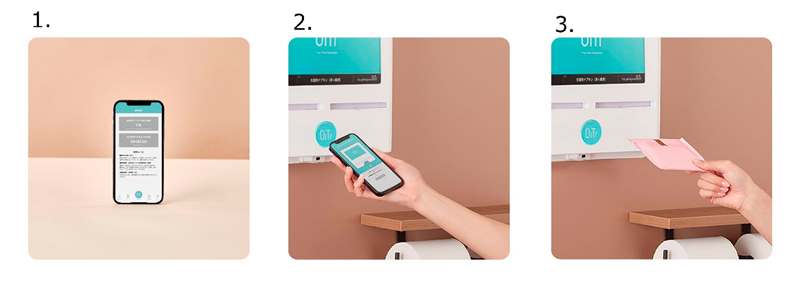
Sumimoto: OiTr is a service that provides sanitary napkins in restrooms in commercial facilities, schools, offices and public facilities at all times, free of charge. Menstruation often starts abruptly. The service was born when people asked, "Why aren't sanitary napkins always available, when toilet paper is always available?" We started this service to reduce the mental and physical burden of menstruation. The business model is to place advertising on the sanitary napkin dispensers, and the advertising fees allow the napkins to be provided free of charge, giving a good impression of the advertising.
Takuma: I remember very well that when I first heard about OiTr's vision and services, I was very impressed. We wanted to work with this company, which has a strong affinity with ovarian cancer awareness, as it also addresses women's health issues. Of course, numbers such as the number of facilities and the number of views are important, but I think the key was that we had the same ambition.
We have raised awareness, but ways to encourage/track behavior change is a future challenge
- Please give us an overview of the project and its features.
Sumimoto: We selected commercial facilities, offices and transport facilities that are frequently used by the age group with the highest incidence of ovarian cancer in the Kanto and Kansai regions, including Central Japan International Airport Centrair as an additional facility with special features. In total, we installed 995 units in 56 facilities.
Takuma: The 15-second awareness-raising video was shown over a period of about two months. It was challenging to make a short video on a small display and without sound, so we discussed every day and created the video with our in-house creative team. We wanted to encourage behavioral change, so I think the key was to include the message "Check your ovaries during regular gynecological check-ups" in the short video.
Eguchi:One goal was to get people to access AstraZeneca's website "ovariancancer.com," so we displayed the QR code for the website. However, because it was in a restroom, some people could not take their phones out right there. So, at the same time, we displayed the search terms “ovarian cancer AstraZeneca” to impress them and get them interested in looking it up later.

- Were there any difficulties, and did you try to do anything differently?
Takuma: The design of a questionnaire for people who saw the ad.
Eguchi: Our OiTr service is used via the smartphone app, so push notifications can be sent to people who receive napkins and ask them to complete a survey. This is only for people who have received napkins, not everyone who has seen the ad, and it is a key feature of OiTr that conversions can be achieved through OOH (Out of Home) advertising. We had a lot of discussions about what kind of content we should use.
Sumimoto: The response rate for the push notifications was around 11%. It is quite high as the response rate for the OiTr surveys is between 8-10%. The response rate was particularly high this time because women were interested in topics related to women's health, such as ovarian cancer and gynecological check-ups.
Takuma: The affinity between OiTr's services and women's disease awareness may be high. The survey results show that approximately 80% of the respondents did not know much about ovarian cancer, so we believe we have achieved our main objective of raising awareness of ovarian cancer.
In terms of behavior change, the push notifications were sent the night the napkin was received, so it is not possible to track whether they actually went to the doctor. We tried to devise a questionnaire with six or seven questions to check whether they were motivated to go to a gynecologist for a check-up, but it was quite difficult. Eventually, we included the question "Do you see your gynecologist regularly?" and if the answer was yes, we asked "Would you consult your gynecologist to have your ovaries checked at your next gynecological check-up?" If the answer was no, we asked "Would you go for a gynecological check-up to have your ovaries checked?" As approximately 80% of the respondents answered that they would like to see a gynecologist for a consultation, we believe that the survey had a certain effect in terms of encouraging behavior change.
Sumimoto: Recently, we put the QR code on signage saying "Please complete a survey to help us continue to provide free napkins" and we received responses from people who do not use OiTr's service. Many of them gave reasons such as "I want to be part of OiTr's efforts" or "I am interested in this kind of activity." These people may also be interested in disease awareness. There is still room for improvement in the way we conduct the survey.

- What have you learned from this collaboration?
Eguchi:While I found it difficult to verify the results of OOH advertising, including restroom signage, I learned a lot from Takuma-san's approach and perspective of tracking various data, such as "the number of napkins received per person per month," and trying to formulate hypotheses from that data.
Takuma: I often asked "Can't you get this kind of data?" Even when you cannot get data, you responded sincerely, saying, "We don't have that data, but we might be able to provide this kind of data," which we really appreciated.
Eguchi:I thought I had to do it, and I had never done anything so in-depth before, so it was a great learning experience for me.
Takuma: I was worried that you would hate me (laughs), so I am glad if I had a positive impact!
Sumimoto: OiTr is gaining recognition as a femtech company, and we would like to work on improving women's wellbeing. Most of OiTr's signage ads promote goods and services, and this was our first disease awareness activity. We are pleased to have achieved such results and believe we can use this experience in our future activities.
Takuma: The method of tracking behavioral changes is still a major challenge, but through repeated projects like this, we can brush up our data collection and survey methods. I think the good thing about i2.JP collaborations is not that we aim for perfection from the start, but that we can inspire each other through trial and error and use that in the next stage of the project. If you want to educate the target group for a disease, this method can be extended horizontally, right?
Eguchi:The number of dispensers exceeds 2,600 and will continue to expand nationwide. This is great if you want to start small, and we also want to try experimental projects.
Takuma: Considering your concept and services, I realized that it is a good fit with women's health issues. We hope to utilize this approach in disease awareness, especially for women.
※The information in this article was current at the time of the interview. Please note that affiliations, etc. may differ from today.
※Please click here to read part 2 of the ovarian cancer disease awareness project, "Disease awareness seminar collaborating with influencers".
For inquiries
Interested in joining us?
Thank you for your interest. We will get in touch soon.